CASTELLANO + ENGLISH ↓
-
La Free Music School ha estat col·laboradora orgullosa d’Arts of the Working Class durant els darrers dos anys i ofereix aquest diari de carrer a la venda a través del web de la Free Music School, amb opció de recollida a l’escola. Tots els ingressos d’aquestes vendes es destinen directament a donar suport a la Free Music School, ajudant a mantenir el lloguer pagat i l’espai obert.
Un diari de carrer multilingüe sobre pobresa i riquesa, art i societat: Arts of the Working Class es publica cada dos mesos i inclou contribucions de persones creadores i pensadores de diferents àmbits i en diverses llengües. Els seus principis es basen en la classe treballadora, és a dir, en tothom, i informa sobre tot allò que pertany a tothom. Tothom qui ven aquest diari de carrer obté ingressos directament. Les persones venedores conserven el 100 % de les vendes. Cada persona artista la feina de la qual s’hi anuncia participa en la construcció del seu contingut. AWC és publicat per Paul Sochacki i María Inés Plaza Lazo per als carrers del món.
Més informació a https://artsoftheworkingclass.org
-
La Free Music School ha sido una colaboradora orgullosa de Arts of the Working Class durante los últimos dos años y ofrece este periódico de calle a la venta a través del sitio web de la Free Music School, con opción de recogida en la escuela. Todos los ingresos de estas ventas se destinan directamente a apoyar a la Free Music School, ayudando a mantener el alquiler pagado y el espacio abierto.
Un periódico de calle multilingüe sobre pobreza y riqueza, arte y sociedad: Arts of the Working Class se publica cada dos meses e incluye contribuciones de personas creadoras y pensadoras de distintos ámbitos y en diferentes idiomas. Sus principios se basan en la clase trabajadora, es decir, en todas las personas, y da cuenta de todo aquello que pertenece a todas. Toda persona que vende este periódico de calle obtiene ingresos de forma directa. Las personas vendedoras conservan el 100 % de las ventas. Cada persona artista cuya obra se anuncia participa en la construcción de su contenido. AWC es publicado por Paul Sochacki y María Inés Plaza Lazo para las calles del mundo.
Más información en https://artsoftheworkingclass.org
-
The Free Music School has been a proud collaborator with Arts of the Working Class for the past two years and is offering this street journal for sale through the Free Music School website, with pickup available at the school. All proceeds from these sales go directly toward supporting the Free Music School — helping keep the rent paid and the space open.
A multi-lingual street journal on poverty and wealth, art and society: Arts of the Working Class is published every two months and contains contributions by artists and thinkers from different fields and in different languages. Its terms are based upon the working class, meaning everyone, and it reports everything that belongs to everyone. Everyone who sells this street journal earns money directly. Vendors keep 100% of the sales. Every artist whose work is advertised, designs with us its substance. AWC is published by Paul Sochacki and María Inés Plaza Lazo for the streets of the world.
Learn more at https://artsoftheworkingclass.org.
Video:
María Inés Plaza ens presenta Arts of the Working Class: Relationships, 16 de novembre de 2025.
María Inés Plaza introduces us to Arts of the Working Class: Relationships, November 16, 2025.
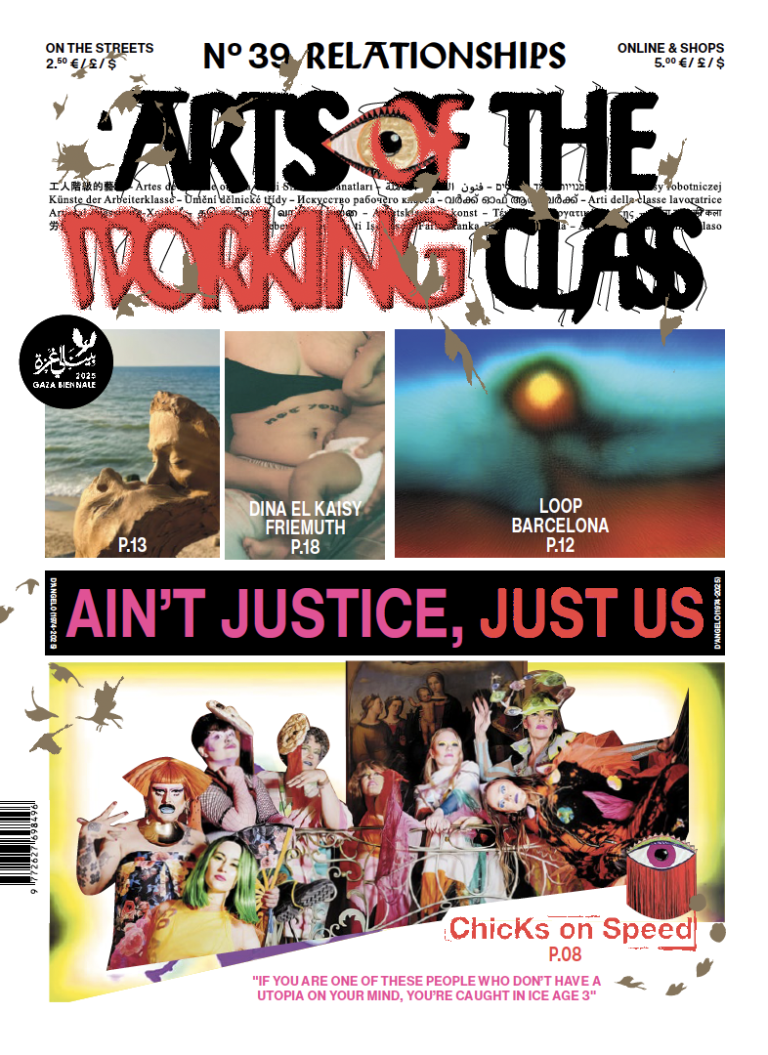
This fall, a small fleet of boats set sail under the banner of the Global Sumud Flotilla: a fragile choreography of resistance and solidarity carrying artists, activists, and ordinary people with ordinary jobs, determined to breach the maritime siege of Gaza and make visible its destruction and occupation. The flotilla was never only about reaching its destination. Its value was measured not in success nor in spectacle, but in risks shared, solidarities enacted, and futures imagined together against overwhelming odds. This understanding of solidarity as practice is what Chicks on Speed underline in their survey exhibition at the newly reopened Villa Stuck in Munich.
As this year’s editorial cycle was titled Value Attachment—a poetic and materialist inquiry into how we assign worth to our worlds—the Sumud Flotilla offers a paradigm for what that question truly entails. The Gaza Biennial reasserts, in its own terms, the primacy of relationships as the ground on which politics is built. Not relationships as networks of exchange or capital, but as infrastructures of mutual dependence and resistance: fragile, chaotic, complex, indispensable.
Across the previous four issues in 2025, we have traced how this question recurs across different registers. Now, we turn to Relationships: to sentimental versions and terrains of struggle. Fascism, in its twenty-first-century iterations, thrives not only on nationalism and exclusion but on dismantling relational life: isolating, atomizing, privatizing it until solidarity becomes suspect and empathy itself a form of dissent. Proximity is policed, intimacy is surveilled. Love is reduced to transaction. Care is outsourced. Trust weaponized. Even friendship, the most basic form of political relation, is co-opted as a tool of influence and control.
The question is no longer whether relationships have political significance, but whether politics is even possible without them. This question is what the paintings of Arturo Kameya, last spring during the Amsterdam Art Week, and the poster by Russel Hlongwane and Lo-Def Film Factory (Francois Knoetze, and Amy Louise Wilson), in collaboration with the transnational project “99 Questions” at the Humboldtforum, address. To relate, and to persist in relating, is to resist the logics that seek to divide society. The works introduced as part of this year’s Loop Festival in Barcelona show how to rebuild forms of attachment that cannot be monetized, mapped, or monitored. It is to construct alliances that do not obey the imperatives of state or market, as well as to recognize that the liberation of an individual is entangled with the liberation of all—from the remaining streets of Gaza to the rainforests of the Amazon, from picket lines to refugee kitchens. It is to insist on anti-fascism as the departure point for the future.
The art world is not exempt from the same kinds of pressures. Too often, the language of community, engagement, and care is reduced to branding, sponsorship, and visibility, reproducing the hierarchies it claims to critique. Institutions extract value from relational labor that lacks redistributing power. Exhibitions, biennials, and programs become performances of solidarity rather than its practice. Filippa Ramos tells us, in conversation, how she works against this contradiction: by maintaining a sort of sobriety.
Calling out complicity is not enough. Constructive engagement demands that art institutions and practices build relationships that resist co-optation. This means, as our contributors argue, valuing labor—emotional, intellectual, and physical—not only within the narrow grid of art historical discourse but in material and permacultural reciprocity. It means placing relationality at the center of decision-making rather than treating it as decoration. In doing so, art becomes a social infrastructure rather than a simulacrum of it.
D’Angelo (1974–2025), now our ancestor, reminded us that in a world that denies justice at every turn, there “ain’t justice, just us.” In our attachments, in our persistence, in the care we give and receive, these are the places where the only justice possible is born.
With contributions by:
Octavia Abril, Anuscheh Amir-Khalili, Knut Birkholz, Catwing, Chicks on Speed, Clemente Ciarrocca, Sepp Eckenhaussen, Michel Esselbrügge, Will Furtafo, Giulia Ottavia Frattini, Dina El Kaisy Friemuth, Gaza Bienniale, Gluklya, Tris Hedges, Russel Hlongwane, Lo Höckner, Amelie Jakubek, Jean Kamba, Arturo Kameya, kina from ver.di, Francois Knoetze, Loop Barcelona, Dalia Maini, Julia Montilla, Diógenes Muniz, María Inés Plaza Lazo, Krishan Rajapakshe / Nachbarschaftshaus Urbanstraße e.V., Lilo Ruminawi, Spore Initiative, Catwings, and Amy Louise Wilson.
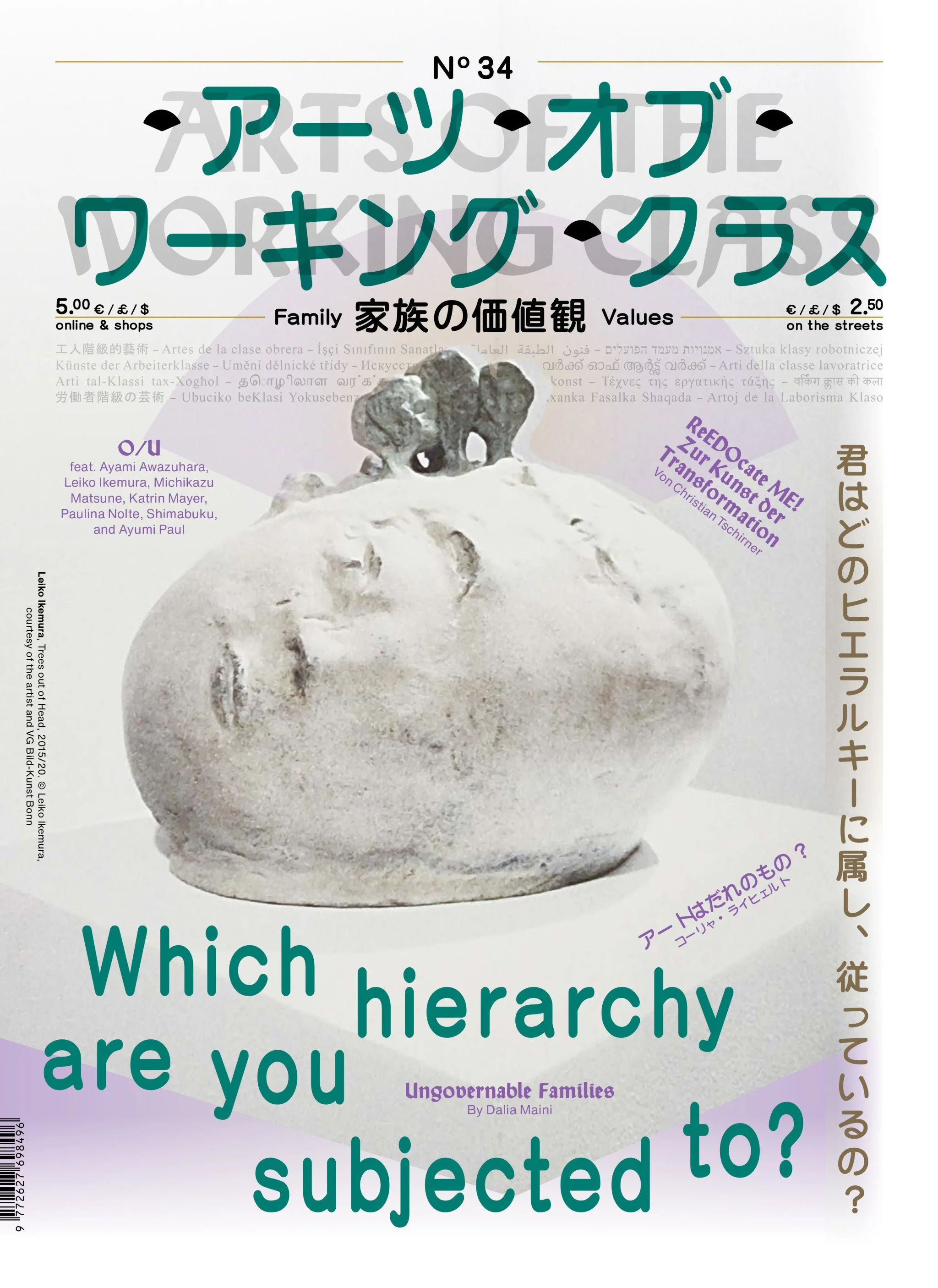
Is our family like a tree, firmly rooted, or like a fan, unfolding in many directions? The notion of family has long been framed as a stable, secure entity. Yet today, family values are shaped by forces that generate profound insecurity— economic, ecological, and social. Drawing from Astra Taylor's insights in The Age of Insecurity, this issue exam- ines how systems designed to create security, like money and property, paradoxically deepen our anxiety and uncertainty.
As we approach the end of a year marked by wars and destabilization, we rethink the family nucleus as more than just a biological or historical unit. We explore it through artists like Ayumi Paul, Danh Vo, and Leiko Ikemura, who offer alternative visions of interconnectedness. Taylor’s argument that capitalism is an “insecurity-producing machine” applies here, as the traditional family model is manipulated by power structures to uphold inequality, creating both division and a false sense of safety.
Inspired by Japanese graphics from the Edo period (1603–1868), safeguarded at the Langen Foundation— celebrating its 20th anniversary as a family-run art collection—we explore how contemporary artists reinterpret the era’s sustainable practices of togetherness, where human and ecological bonds coexisted in both peace and crisis. Through artists like Michikazu Matsune and Ayami Awazuhara, we see how family ties, like other social structures, are fluid and shaped by their surroundings. Yet, as Taylor notes, insecurity invites solidarity. Even the privileged are not immune to financial or environmental precarity, as Joshua Citarella and Catherine Liu discussed in their conversation on the rise of the new managerial class.
As curator Sohrab Mohebbi reminds us, “Art is where we practice freedom,” and that freedom opens new possibilities for collective strength. In this light, artists like Paulina Nolte, Malte Bartsch, and Katrin Mayer explore how expanding our concept of families—and by extension, cities and societies—can offer a path toward resilience. We hope you enjoy this edition, carefully curated to introduce Arts of the Working Class in Japan first as an e-paper and now in print on the streets of Berlin and elsewhere.
Impressum / Imprint
Founders / Publishers / Directors
Verantwortlicher i.S.d . 18 Abs. 2 MStV María Inés Plaza Lazo, Pauł Sochacki
Managing / Artistic Director
Amelie Jakubek
Editor in Chief
Dalia Maini
Editorial Assistance
Rita Torres
Artistic Project Development & Distribution
Theresa Zwerschke
Administrative Assistance
Selma Louise Christoph
Proofreading
William Kherbek
Translations
Takashi Arai
Designer
AWC feat. Manuel Bürger
Online Design
Giorgia Belotti
Circle of Support - Volunteers:
Donald Eubank, Hassoumi Moctar Agali, Amina Zerourou, Ruslana Shabelnyk, Nina Abba, Hannah Lu Verse, anna zrenner, Sophie Franziska Schultz, Kira Schmitz, Nadine Bajek, Cora Pagano, Yasemin Şenkal, Lukas Grube, Duarte Eduardo, Felix Dengg, James Rhys Edwards, Louisa Maria Stank, Sophie Hartleib, Teresa Mayr, Leo Baumgärtner, Katharina Thurow, Annalisa Giacinti, Mia Ribeiro Alonso, Line Lange, Noa Jarri
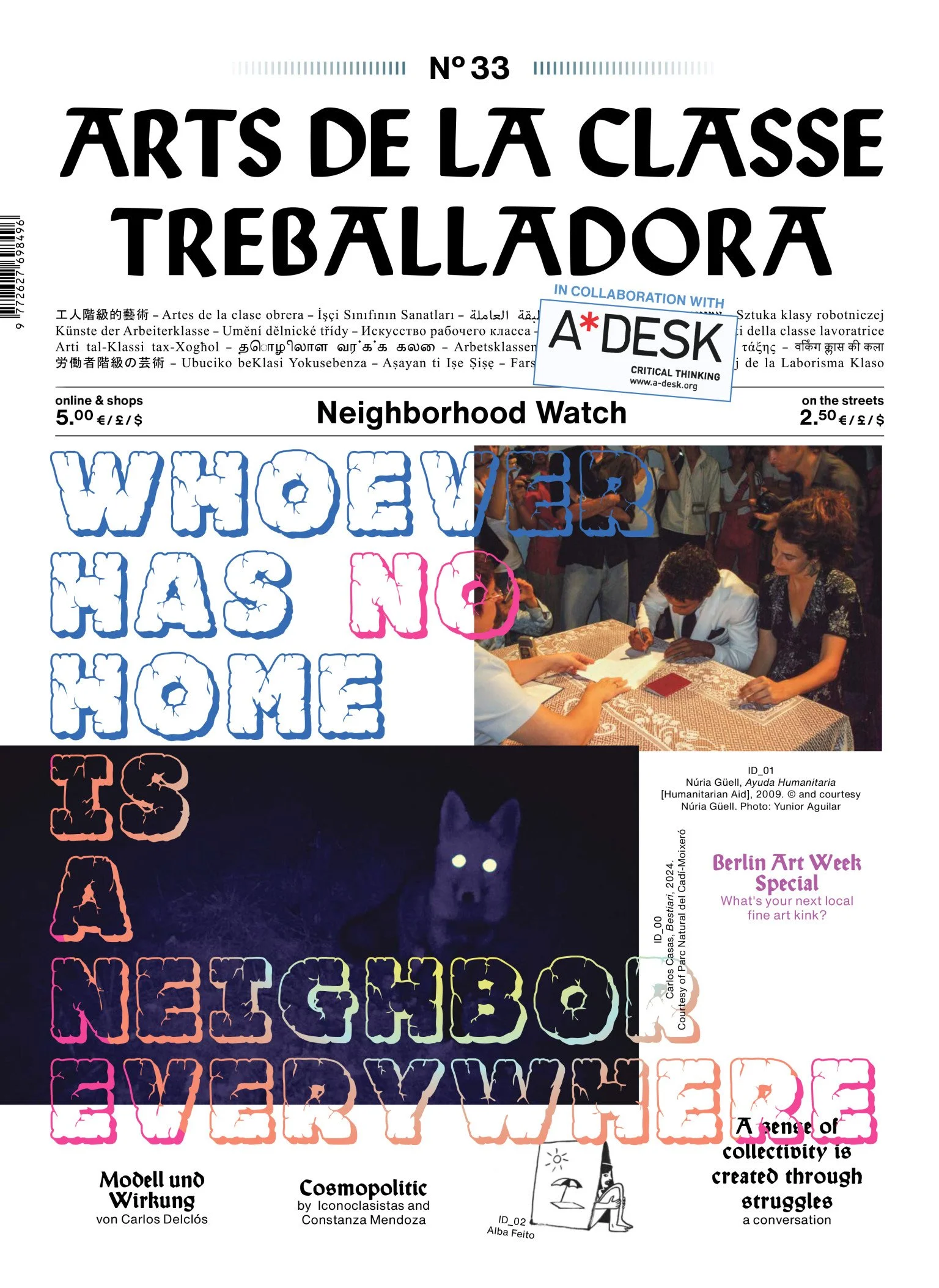
The term "glocality" is often paraded as a beacon of progress, a concept that seamlessly blends the local and the global. Yet, this ideal often conceals the deep-seated inequalities and systemic violence that prevent cities from being cohesive networks of beings. In cities such as Barcelona and Berlin, where privilege and exclusion glaringly define their structures, the notion of "glocality" masks the harsh realities faced by those marginalized by capitalism’s relentless advance. The romanticized notion of cultural blending too often ignores this quiet but clear devastation.
We have exchanged gazes and ideas with the Berlin-and-Barcelona-based editors of A*Desk, Montse Badia, and María Muñoz, to refresh once again our commitment to critical dialogue achieved through a polyphony of multi-situated voices. The issue, titled "Neighborhood Watch/Ojos de Barrio”, examines annual and biennial events such as Manifesta 15 and Berlin Art Week 2024 to take their collectives into account for how art becomes a tool for finding cracks in the monolith of urban wealth accumulation, where communities can breathe and flourish and neighborliness counterposes the aridity of profit and gentrification. It’s an invitation to recognize that scarcity is one of the main modus operandi in the arts, by navigating the brutal intricacies of its most sordid form of attention specular to capitalism.
A*Desk, deeply embedded in Barcelona’s cultural fabric, has long been a haven for critical revision and resistance to the alienation of culture against the backdrop of gentrification. Thus, AWC (re)visits and translates previously published essays and conversations from A*Desk’s online platform which refuses to carve out spaces of plural belonging, but rather defines them. We want to query a few things with you, reader, in between the cities: how do we navigate fractured realities? How do we build resilient communities against the tides of gentrification and displacement? How does art actively reshape, not merely reflect, the spaces we inhabit? These are not abstract musings - they are the lived experiences of the artists and art workers featured in this issue. Their work is a testament to the power of art to reveal and resist, to nurture connections, and to root us in a shared struggle for dignity and belonging.
Indeed, the collaboration between A*Desk and Arts of the Working Class is more than an intersection of ideas - it’s an opportunity to rethink the indispensable roles of independent realities within the cultural system and to envision new ways of connecting and supporting one another in our differences. We are committed to extending the invitation, as Arts of the Working Class begins to leave its mark on Barcelona’s cultural landscape hand in hand with A*Desk, and in complicity with Michael Hart, our new partner in crime, and the members of his Free Music School, a wonderful gathering place for the dwellers of Poble Sec. Let us use perennials, art fairs, and gallery weekends not just as a means to observe, but to become active in shaping a more historically and politically engaged collective consciousness as an expression of the arts' unresolved social role. Only then can art stop being merely a reflection but a powerful force for transformation, grounding us in our shared struggle and collective hope. Social change may be only a few blocks away from you if you wish to engage.
This issue features Abolitionist Jelly, Alba Feito, Amelie Jakubek, Amr Amer, Ana Alenso, Anonymous, CHTO DELAT INTERNATIONAL, Calla Henkel and Max Pitegoff, Carlos Casas, Carlos Delclós, Carolina Campos, Center for Plausible Economies, DMT, Dalia Maini, Dani Gasol, Danielle Brathwaite-Shirley, Diana Padrón, Désiré Feuerle, Eli Cortiñas, Faltas, Fito Conesa, Gisela Chillida, Federico F. Giordano, Gitschiner 15, Glòria Guirao Soro, Grayson Earle, Helios (Ilyas) F. Garcés and Nancy Garín Guzmán, Iconoclasistas and Constanza Mendoza, Inés Plasencia, Irina Mutt, Jeremy Deller, Jokkoo Collective, MMX (María Inés Plaza Lazo, María Inés Plaza Lazo, María Muñoz-Martínez, Michael Hart, Miralda, Montse Badia, Nuria Güell, Pilar Cruz Ramón, Rico Zyrrano, Ro Caminal, Sara Ouhaddou, Selma Selman, Shibboleth, Taína Cruz, Tracey Snelling, and Xavier Acarín), ver.di.
Impressum / Imprint
Founders / Publishers
Verantwortlicher i.S.d . 18 Abs. 2 MStV
María Inés Plaza Lazo, Pauł Sochacki
Managing / Artistic Director
Amelie Jakubek
Editor-in-Chief
Dalia Maini
Guest Editors
Montse Badia and María Muñoz-Martínez (A*Desk)
Artistic Project Development & Distribution
Theresa Zwerschk
Administrative Assistance
Selma Louise Christoph
Distribution Assistance
Miguel Angel Espinoza
Proofreading
William Kherbek
Translations
Léa d Allexandre
Kurt Hollander
Huda Zikry
Online Design
Giorgia Belotti
Circle of Support - Volunteers:
Hassoumi Moctar Agali, Amina Zerourou, Ruslana Shabelnyk, Nina Abba, Hannah Lu Verse, anna zrenner, Sophie Franziska Schultz, Kira Schmitz, Nadine Bajek, Cora Pagano, Yasemin Şenkal, Lukas Grube, Duarte Eduardo, Felix Dengg, James Rhys Edwards, Louisa Maria Stank, Sophie Hartleib, Teresa Mayr, Leo Baumgärtner, Katharina Thurow, Annalisa Giacinti, Mia Ribeiro Alonso, Line Lange, Noa Jarri